A Strategic Policy Manifesto for Vice President Hon. James Wani Igga
South Sudan stands at a critical historical crossroads. To move from post-conflict stabilization to enduring prosperity, the nation requires a leader rooted in institutional memory, diplomatic strength, and a relentless focus on modernization. Hon. James Wani Igga embodies this blueprint—combining statesmanship with a forward-looking vision centered on human dignity, technological leapfrogging, and comprehensive infrastructural and agricultural overhaul.
PILLAR I: HUMAN-CENTRIC GOVERNANCE & SOCIAL WELFARE
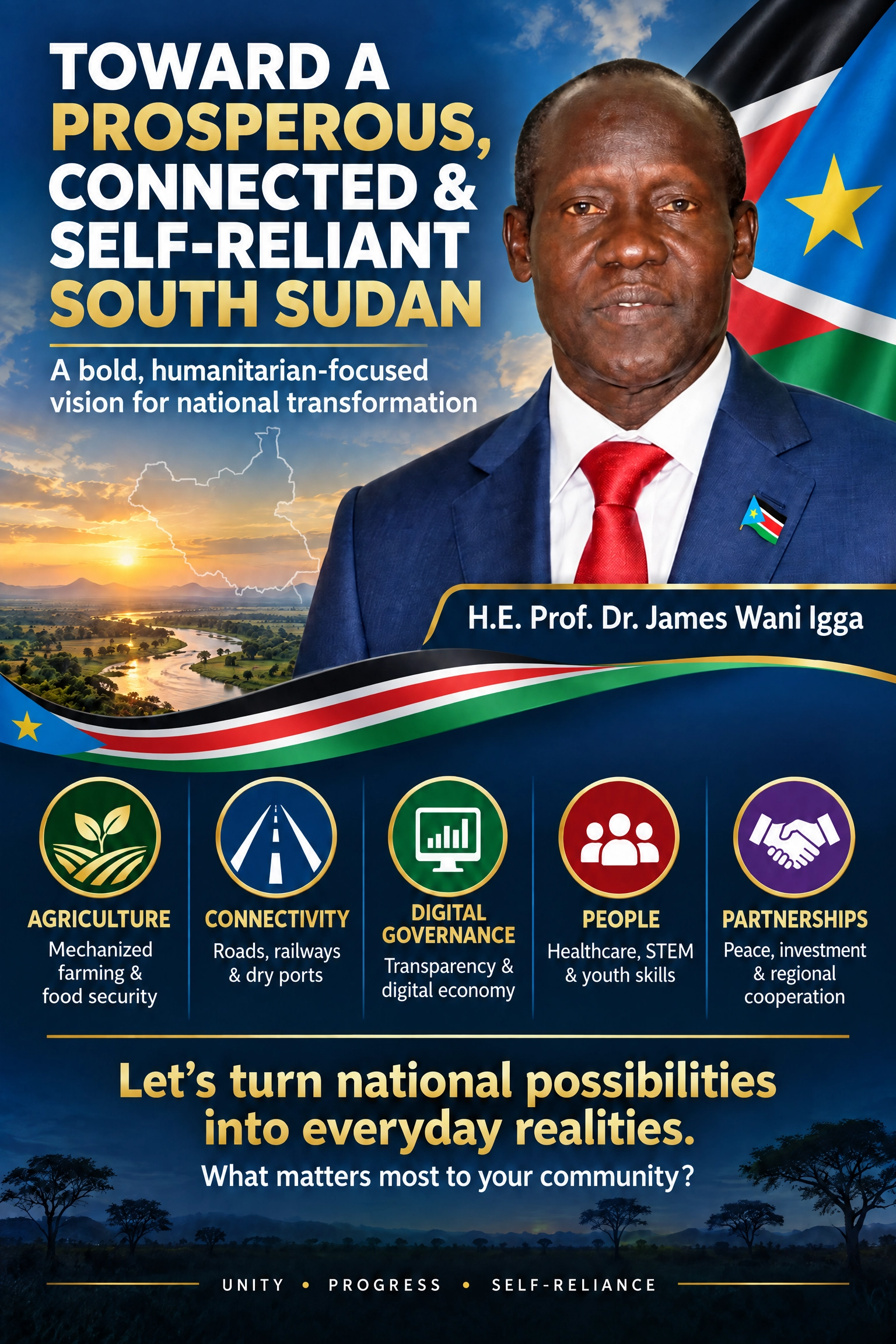
Placing the dignity, safety, and upliftment of every South Sudanese citizen at the heart of public service.
- Universal Healthcare Access: Upgrading primary care networks, establishing regional specialized medical hubs, and securing reliable pharmaceutical supply chains.
- Modern Education & STEM Focus: Overhauling public school curricula to emphasize technical-vocational training, digital literacy, and critical sciences to empower the youth bulge.
- Civic Empowerment & Inclusion: Strengthening community-level participation, protecting social safety nets, and ensuring gender-inclusive representation across local and national governance structures.
PILLAR II: TECHNOLOGICAL REVOLUTION & DIGITAL GOVERNANCE
Leveraging 21st-century innovation to transform public administration and economic productivity.
- E-Government & Transparency: Digitalizing public registries, revenue collection, and civil services to eliminate corruption, streamline bureaucratic efficiency, and maximize state transparency.
- Digital Infrastructure Expansion: Expanding broadband connectivity, mobile money networks, and tech hubs to integrate rural populations into the national digital economy.
- Data-Driven Planning: Utilizing modern geographic information systems (GIS) and data analytics for disaster management, urban planning, and resource allocation.
PILLAR III: AGRICULTURAL TRANSFORMATION & FOOD SECURITY
Unlocking South Sudan’s vast arable land to transition from dependency to regional breadbasket.
- Commercial Mechanized Farming: Shifting away from subsistence models by introducing modern farming equipment, localized seed banks, and advanced irrigation systems.
- Agribusiness Value Chains: Establishing local processing plants, storage facilities, and refrigeration networks to minimize post-harvest loss and create rural manufacturing jobs.
- Cooperative Financing: Providing smallholder farmers and agricultural cooperatives with micro-loans, insurance, and direct market access.
PILLAR IV: STRATEGIC INFRASTRUCTURE & MULTIMODAL LOGISTICS
Building the physical veins of commerce to connect domestic markets and lower the cost of living.
- National Road and Rail Corridors: Fast-tracking all-weather trunk roads and trans-national rail networks linking production zones directly to urban centers and borders.
- Inland Dry Ports & Trade Hubs: Establishing modern dry ports equipped with customs clearing facilities to optimize international imports and exports.
- Energy Independence: Investing in sustainable, mixed-grid energy systems (hydro, solar, and petroleum-backed baseloads) to power industrialization and households affordably.
PILLAR V: INTERNATIONAL DIPLOMACY & STRATEGIC NETWORKS
Leveraging decades of statecraft to secure sustainable partnerships, investment, and peace.
- Global Economic Partnerships: Engaging international financial institutions, bilateral allies, and private sector investors to secure Foreign Direct Investment (FDI) for mega-infrastructure.
- Regional Integration: Deepening trade and security cooperation within the East African Community (EAC) and broader international bodies to ensure long-term geopolitical stability.
- Peace and Reconciliation Architecture: Utilizing established diplomatic weight to foster internal social cohesion, cross-border trade agreements, and sustainable peace-building mechanisms.
IMPLEMENTATION STRATEGY: THE PHASED ROADMAP
| Phase I | Stabilization & Digitization (Immediate Priorities) | • Audit national infrastructure projects. • Launch emergency agricultural inputs and food security buffers. • Roll out baseline e-governance systems for public finance tracking. |
| Phase II | Connectivity & Industrialization (Medium-Term) | • Break ground on core regional road networks and dry ports. • Implement nationwide digital identity and modern tax collection systems. • Scale up technical-vocational training centers. |
| Phase III | Expansion & Sustainable Growth (Long-Term Vision) | • Finalize multimodal transport (rail/road integration). • Attain national food self-sufficiency and establish processed agricultural exports. • Achieve universal primary healthcare and broad digital literacy benchmarks. |
The Vision: Under the visionary, humanitarian-focused, and technology-driven leadership of Hon. James Wani Igga, South Sudan is poised to unlock its true potential—transforming into a self-reliant, digitally empowered, and globally connected republic.